
...the aristocrats!
on arts education, mass media, and snobbery

Hello, dear reader! I hope you are doing well, or at least something close-to-it, in spite of everything. Happy Pride Month and a happy Father’s Day, to all those who celebrate.
I have to confess that I have been writing quite a lot over the last six months or so, but I thought that none of my work was good enough to actually share. I realized recently that what I was really worried about wasn’t quality, but the risk of offending my friends— particularly those who are suffering, and those who make more money than me, and who occasionally buy my art. Offending one’s friends and patrons is an easy way to go broke, in one way or another.
I think this was a good instinct, when I was writing frequently— it’s kind to think of the audience’s perspective when making anything you intend to give them. But you can see how this impulse has so burdened my mind with anxiety that I haven’t even been sharing anything, which is unfair to the handful of people who keep asking me for new things.
Still, I think I have at last cured my own snobbery-affliction, thank god. Apologies that it took me so long to get here, dear reader, and thank you so much for your patience. Let’s talk about USAmerican snobbery, mass media, and our stupid goddamn culture war.
Edit 6/24: I don’t ~identify as~ a midwesterner because the most political midwesterners I know are evangelical whack-jobs, and because the suburbia I personally grew up in is a far cry from the rural towns we imagine making up the bulk of the midwest. So I originally wrote this piece with a lot of “theys” and “thems.”
But really, I’ve lived in different midwestern cities for 95% of my life, an I did sincerely love those places and the people in them, although they did not seem to love me back. So I am rather more concerned at this point about offending the [especially older & poorer] midwesterners who might read my essays, as if I’m telling them how lame they are at knowing-or-making great things, how ~they shoulda fuck’t off to da big city like me~ etc— I don’t want to rub salt in that old wound.
So I’ve changed some pronouns around, back to a proper “we” out of solidarity for my wonderful, disappointed people. Just in case any of you coastal nerds think I’m ashamed of them or something. You see how useful a little change-of-pronouns can be!
ART FOR BABIES
I was thinking today about Yann Tiersenn, a French composer and multi-instrumentalist musician. He uses a lot of unusual instruments— here he is in 1997, performing his song La Noyee on an accordion and a little plinky-plonky baby-piano.
I think La Noyee is maybe one of the most beautiful songs I’ve ever heard. It feels like dancing through a meadow in the rain, or waltzing as fast as you can with your lover down a dark and cobbled street. I mean, I wouldn’t know what that’s like, but it definitely conjures the imagery and motion, you know?
To be clear, I am showing you this particular video on purpose. I could have shown you this other link, where he is depicted with a black-and-white still photo; the audio is clearer, the piece more expertly-played. Or I could show you this other version, where the song was finalized and filled-out, building to a magnificent crescendo. The latter is the version that wound up in the film Amelie— itself a sort of mass-media patient zero, which infected so many of us Americans with a love for Yann Tiersen’s music.
I just want you to see Tiersen for who he really was, a mere four years before he turned his experimental compositions into the score for Amelie— a boy trying awkwardly to keep tempo with a pile of silly little instruments, his elders sitting at his elbow, utterly unimpressed.
This is a perfect example of what snobbery looks like. It is the stone-faced refusal to acknowledge the genuine skill and creativity of someone who, in one way or another, seems childish.
The artist and their work may be obviously sophisticated— as in, their style is complex and layered, and requires many different skill-sets to master or imitate— they just don’t follow the rules of what their art-form is “supposed” to be, according to prior generations. In this way, creative experimentation gets interpreted as disrespect for one’s creative lineage.
And the artist’s elders perceive their work as either a dismissal-of-tradition or a threat—a degeneration of the art form, if you will. Insert sinister orchestral chord here, etc.
Anyway. As you may know, if you’ve been following awhile, I grew up in midwestern suburbia. My dad was also kind of a shut-in, but he liked spending his lawyer-money on new toys, and so we had at least two PCs in the house at any given time.
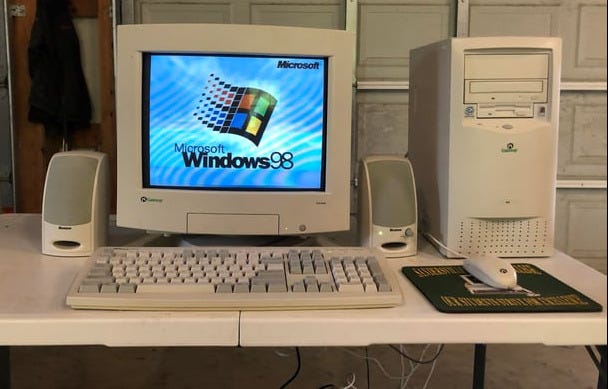
This means that, until I went to college, I was a basement-dwelling computer child. I was one of the few kids in my hometown who was computer-literate starting from about age ten, in the early 2000s.1 My parents didn’t want a kid, and didn’t trust other parents enough to let me have friends; the path-of-least-resistance, then, was to let me sit in the basement while they lived their lives as they pleased. So I was a predictable evolution on the much-maligned “TV Babies” of Generation X, the children of parents too-busy or too-self-interested to spend meaningful time with their kids.
Still, I could not be more grateful for the PC being my one source of freedom in an extremely isolated childhood. Through the internet, I was able to have a social upbringing that was not entirely focused on training me to be an Obedient Christian Housewife or a Republican Patriarch, as my parents had been before me.
I could read about history and international cultures on Wikipedia, read drawing tutorials on DeviantART, draw with more-experienced artists on Oekaki Central and Tegaki E. I could even secretly pirate films and music that my parents would never have approved of, like Akira and The Ring and Watership Down.
So, thanks to being Very Online before the phrase became a pejorative, I found Yann Tiersen completely independent of That Quirky French Girl Movie. In the past, cultural works from Europe and Asia tended to trickle-inwards from the coasts, where they were imported by public broadcasters who managed to rub elbows with visitors from faraway lands. From there, the films and music from other continents would pass from hand-to-hand across the states, until they found themselves somewhere in the middle, where I could see them.
The coasts both fucking hated each other, though, in the last century. LA and New York spent decades feuding for the title of the crowning jewel of American culture, as their wealth grew and hungry artists appeared begging for meaningful cultural work. While many flocked to the coasts for opportunities, new advancements in mass media & mass communications were slow-to-arrive in the flyover states, usually as locally-owned telephone co-ops and public broadcasting stations.
Academic institutions in the US and Europe have long labored under the belief that it is simply impossible to make art without a comprehensive education in theory-and-craft. So, thanks to their particular sociopolitical situation, the coasts largely still think of the midwest as a place where real art can never be found.
“LOW” ART
…Okay, to be fair, this is sort of true. But it’s not the midwesterners’ fault.
It’s been historically difficult for rural parts of the country to receive funding for anything (least of all arts education), mostly because the country generally just doesn’t think it’s worth it to build things in places where not-that-many-people live. As a result, the few midwestern art schools out there can be fully a decade-or-more behind with regards to their access-to-new-technology. The region has been both structurally and interpersonally disconnected from places with greater diversity-of-influences, and so their local artistic discourses usually occur in relative isolation. There is little social connection or goodwill to be found between middle-America and all-the-rest— or at least, so it was before the internet.
Of course, this bred a midwestern culture which still yet maintains a bubbling resentment towards the coasts and towards the federal government, a rational response to decades-if-not-centuries of infrastructural abandonment and pointless mockery-from-above. People born in rural places are right to be angry, and insecure about whether they are smart enough or good enough to make art. People have been telling them as much for about as long as “fine art” galleries and museums and colleges have existed in the US.
Politicians and professional thinkers tend to believe that a person who farms for a living has no need for art. Obviously, yes they do, same as anyone else; art is there to help us understand our own feelings, to give us narratives by which we might understand the world more-deeply. Those who are disconnected from the wider world around typically fill that spiritual void with religious forms rather than secular Art with a capital A, largely because it’s the only art-form that they and their loved-ones consider trustworthy & morally safe-to-indulge.
So it’s important to me that I make a distinction, here: midwesterners don’t get to benefit much from certain forms of arts education, and the infrastructure meant to provide such things is usually not very good there, at least compared to the highly-honed craft-and-theory-focused education you might find in Europe. Besides— I’m sure it goes without saying that being a teacher in the midwest isn’t a very prestigious, well-paid, secure sort of job, so anyone with serious skills (or who is just looking for better financial opportunities, to support themselves or their family) is liable to flee to anywhere else.
There are plenty of highly-skilled painters in places like Kansas and Oklahoma, as well as beautiful historic museums— but when I lived in the area, the few working artists I saw were still stuck doing boring prairie landscapes. If they even thought about trying anything more edgy or complicated, it was going to scare the hoes, which is always bad for one’s ability to make a living doing anything at all. And so, as always, economics and politics and social-relationships can be deterministic, regarding what art gets made and where the ~challenging~ artists go when they search for safe harbor.
However! What I am not saying is that midwesterners lack for artistic potential or good taste. When midwesterners ignore the “high art” of European film or painting or whatever, it’s not because we are stupid— it’s because nobody taught us how to understand what the fuck we’re even looking at. We make things that seem “primitive” because education is just not equally-distributed across the entire country, or across different economic classes, and it really never has been.
What I mean is: it’s hard to appreciate a filmmaker whose most interesting feature is his camera work and timing unless you know a little something about the general mechanics of how-films-are-made and why-they’re-made-that-way. Most people prefer a blockbuster, because that’s just the kind of film language that we already know how to speak. The same goes for other art forms— other genres, other media, other visual languages, etc.
For instance, I didn’t enjoy the first few comedy specials my boyfriend showed me, because I had never really seen comedy before, and I kind of thought it was stupid and low-rent. I really didn’t understand what was supposed to be funny about things like Michael Bolton’s Big, Sexy Valentine’s Day Special because I didn’t know who Michael Bolton was. It wasn’t until I saw more comedy films and sketches and improv, and learned a bit about why-and-how they were made, that I began to appreciate all of the comedy he showed me. Same with art house films and paintings and music and so on— you have to know what you’re seeing before you can form an opinion about it beyond first-impressions.

Anyway. The wealthiest parts of the country have spent decades just sort of refusing to share with the midwest, and even when we try, the midwest is not listening. Naturally, rural-living people (and their loved ones) have little reason to trust “the elite,” who continually treat them as if we are culturally-irrelevant, disposable labor. Rural locations typically have less coverage by hospitals and fire stations, and are always the last to receive copies of any new infrastructure that large cities simply build for themselves. You can imagine what happens: kids like me fuck off for greener pastures, and not only for cultural reasons.
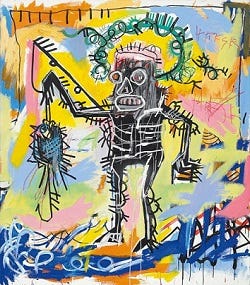
Why does that cunt Pollock get to show in galleries in Europe? asked the forlorn midwestern artists, quite reasonably, during the Cold War. Why should I give a shit about ““““action painting?”””” My fucking kid could do that.
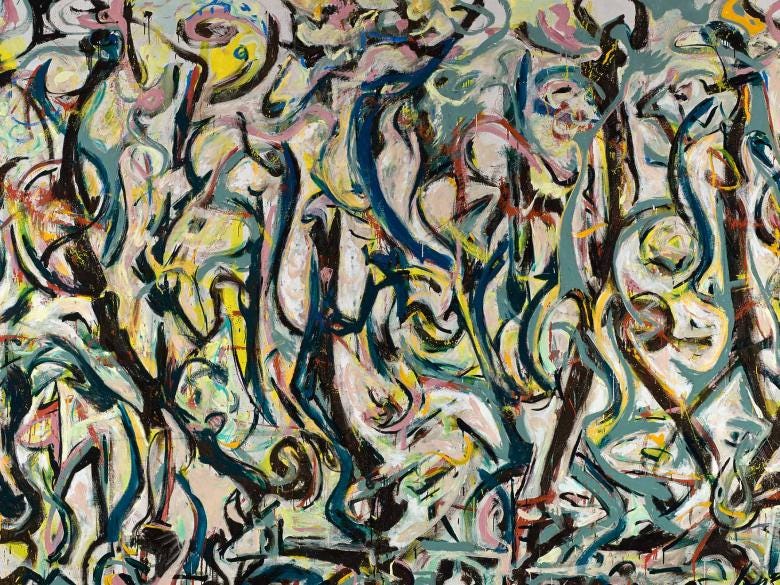
Anyway. Midwesterners, disappointed as we are, are still perfectly capable of recognizing good art that doesn’t have a CERTIFIED WEALTHY PEOPLE APPROVED sticker on it. We are can notice the excellence in works that others consider low-brow just for being cheap-to-produce, without all that much explaining.
So naturally, by the time I was a teenager in the 2000s, it was possible to find Hayao Miyazaki’s Spirited Away or Satoshi Kon’s Millennium Actress on the shelves at VHS rental places, even in tiny rural towns in Kansas and Missouri. Anime films-and-shows were foreign imports that equalled (or outshone!) Disney animated features, in terms of their quality, but they were largely ignored by arts academia. Even when critics raved about the obvious greatness of Studio Ghibli films like Princess Mononoke, most American and European galleries-and-schools still struggled to take animation seriously as a complex-but-teachable art form.2
Anyway. The internet is a form of mass media, too, in case you hadn’t noticed, but it is also a form of mass communication. If you had to explain it to your grandma who lives in a trailer in the Ozarks in the ‘90s, you could just tell her that the internet is like a television, a telephone, and an encyclopedia all at the same time. I know it’s easy to get all ~hysterical~ about social media these days, but really, that’s all the internet has ever been. And it’s great for learning about art.
Long before I ever went to college, I was reading the art-instructional work of people like Marcos Mateu-Mestre and George Bridgeman and Will Eisner, recommended-or-reposted to the internet, which is why my midwestern art school was basically useless to me.3 The only teachers present, who knew how to teach me what I actually wanted to learn were shuffled around in my senior year, so I never actually got to take classes with them. So it goes, when you live in a place with a shortage of both expertise and money-to-pay-for-it.
Anyway. Much like my art education, I also found Yann Tiersenn’s music online. I heard him first through this video, which is… a little bit hard to explain.
The above-linked is a match-cut compilation of different video-captures of Marionette, a performance piece put on by a Korean b-boy dance collective called Expression Crew.4 The original is a 90-minute stage show, so this is just a preview, put on YouTube by some fan who probably wanted to practice video-editing, or who just thought it was cool and worth-sharing. This exact video is how I, as a shut-in midwestern fifteen-year-old, learned that Koreans know what breakdancing is, and that dancer is a real job you can have.
It’s an old crunchy video, but you can see how mass media helped create a mutually-beneficial network of cultural exchange. The video cycles through different performances in all different settings— one recording looks to be at some form of Walt Disney park, one looks to be in a windowless community center somewhere, one is on a stage with giant screens and stage lights looming in the background. So, in spite of its tech specs, I’m confident in calling this “art,” or at least a recording-of-it.
Expression Crew was, by any measure, an international performance art collective of high regard. But when I showed this video to my dad, a Harvard-educated lawyer who grew up poor in the midwest, he said “I guess these are, what, unemployable people?”
Expression Crew are still around, although now there are many more Korean dance crews posting videos to social media, too. I mean, they always seemed pretty “employed” to me. But unfortunately, snobbery is infectious; you can bring it back home with you.
If you are a midwesterner who escaped farm labor by being good in school, like my father, you might decide that your mind is more valuable than the work of your neighbors— while they call you a limp-wristed desk-sitter for not working with your body instead. Even if you are a lawyer, like my father, you still must always justify that your work is realer than someone else’s— usually artists, the most “useless” form-of-employment one can have.
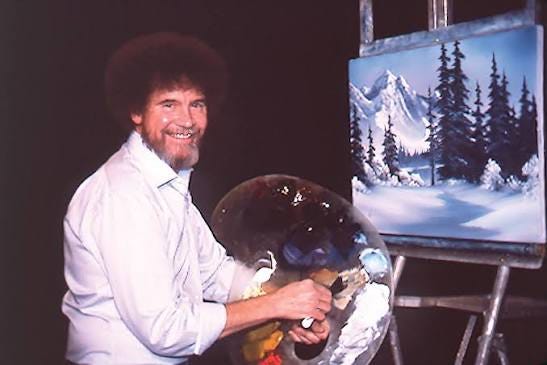
This is especially true when the only arts education your average PBS-viewer has access to is Bob Ross. It’s hard for the average person to trust any art that requires more context to understand than a landscape, or which is not personally immediately appealing to them. The finer details regarding art history, art theory, and the political context(s) that shaped them have all been hidden from the masses for so long that we rarely trust those who might be able to teach us more about them.
Anyway. Marionette is the sort of “melting-pot art” you get from just… having cross-cultural exchange. Koreans only first learned about breakdancing thanks to VHS tapes imported from the USA; YouTube serves basically the same function today, but far fewer steps in between. The average person with a phone or desktop can be exposed to cross-cultural influences, and they naturally make art which references those influences, intentionally or not.
That’s good! Or at least, it’s inevitable. It’s not a big deal as long as everyone involved is friendly to each other about it.
Cultural exchange turns into cultural appropriation only when the wealthy-and-well-connected profit by elevating the work of their (literal or political) subordinates without giving them a fair share of the profits. The peoples who originate an art-form— individuals or whole societies who invent new instruments, or new techniques for dancing and singing, or who find unique materials for sculpting and weaving, etc etc— are basically left behind in the dirt while other people get rich off of copying them.
Personally, I am not inclined to think of Marionette as cultural appropriation, at least not any more than American martial arts schools are appropriative in the other direction. Mainly because, around the same time as I found Marionette, I was watching other videos of high-production-value Black culture— the works of another group of people often appropriated-from by the wealthy & white.
Like, for example, Fik-Shun dancing on stage in Vegas. It felt like hip-hop was exploding during my childhood in the ‘90s and ‘00s, and it was fucking awesome.
This video is likewise Real Art as much as any ballet, even though the performance has commercialized set-dressing. Dushaunt Fik-Shun Stegall has better control of his muscles and movements than any ballerina or ballroom-dancer I’ve ever seen, and he does more interesting things with the medium of dance than the shambling iterations of old-world art that still exist today. People just don’t take this kind of thing seriously as a legitimate part of American culture because he’s dancing to a dubstep remix of a pop-rap parody of a children’s song.5 As if that makes any fucking difference.
I love Fik-Shun, and I love dancers-in-general. I find them very impressive, as artists and athletes, and I generally enjoy the work of artists who work in mediums different from my own. (How else could I have gotten into writing, as a guy whose main skill-set is drawing and painting?)
More than that, Fik-shun was one of my earliest masculine inspirations. His image of masculinity was literally aspirational to me as a teenager, and not because he had money or seemed kind-of-famous. He was one-among-many who helped give me the courage to transition, because he showed me I would not have to turn out exactly like my dad. His version of masculinity felt appropriate for the post-feminist millennial age. He showed me that you can be an adult— as in, someone-who-is-taken-seriously, at least by someone, somewhere— and still be playful, creative, expressive, etc.
Fik-Shun is not even a particularly unique talent— there is certainly no shortage of excellent Black dancers in the world— he’s just a fashionable dude with a bright smile, who is clearly having a blast pursuing his particular creative passions for an audience, and doesn’t seem to care if anyone thinks he seems immature. Add that to the list of things that separate him from ballerinas, I suppose— ballerinas are rarely happy about the bone-destroying requirement that they must stand en pointe if they want to participate in the art-form at all.
REAL ART
I hope you see through these examples that this is how art and culture works— or at least, how it has worked in the USA for my entire lifetime, and likely much longer. College gets more expensive while livable jobs disappear, public-school arts education loses funding and public-access disappears, and the critics all forget that their actual job is to be teachers. As a result, all of the country’s mass-media comes to resemble an ignorant, antisocial slop-factory, until everyone is dismissive over any piece of art that is merely boring, confusing, popular, or unusual. And all along, the difference between the wealthiest and poorest among us gets worse, and worse, and worse.
In general, the US has always been insecure about our artistic-and-industrial capacity, mostly because western Europeans seem to think of the US as a country of disobedient children. Coastal old-money families— who have historically had more chances to actually meet Euro-snobs, and thus be personally condescended-to by them— want very badly to prove themselves worthy in the eyes of “the West.”
This was not realistically possible at-scale before the internet let us all grow up with international friends, learning about different art-forms and styles from peers rather than superiors. But it seems that right now, everyone is too busy having Internet Hysteria to realize the positive changes that came with the invention of global mass-communication.
So our national-and-personal insecurity has been reflected within, towards self-hatred for our own country’s various genres of cultural-output, particularly those made by the poor and un-credentialed. Not because we are collectively self-aware and ashamed of the fact that our institutions have been irresponsible with deciding which art they are willing to dignify, and not because we are willing to acknowledge that wealth disparity has always been a fairly extreme problem in the USA. We more-often just get mad that each work-of-art or art-movement is not exactly what we would make ourselves, if only we had the chance. And so we forget to be curious, and forget how to appreciate unfamiliar things on their own terms.
But y’know what? It’s fine. There is always great art being made, everywhere, all the time, if only you know where to look. The internet is a fantastic place to find instruction, mentorship, and collaboration. The overproduction of homogeneous, commercialized slop tells you more about whether the people who decide what-gets-made-and-shared have their heads too far up their own asses to look for great art in the places it actually lives.
In general, new art forms and interesting innovations trickle up and out, from the poor and the shut-in hobby-obsessives up to the relatively-richer-and-thus-more-conformist, and then from the rich to everyone else via mass media. From there, the profiteers get hold of it, and the overall vibes in the medium get worse in predictable ways— everything gets boring, obtuse, overwrought and/or pointlessly mean. The next generation inherits the mean-ness and insecurity, but not the detailed contextual understanding of where it all came from, and so the cycle repeats until something breaks and a new creativity is found once again. I mean, it’s more complicated than that, but that’s the gist of how things work here.
This is why arts education matters, and why media literacy is an essential skill for survival in modern times. A culture war is just what you get when basically all of the infrastructure for providing these things all decide at once that their job is to fix the culture, rather than to water it until it blooms.
So, at this point, the only thing left that trickles down in this godforsaken country is snobbery. And yeah, a lot of it is fucking racist as hell— not necessarily in the heart-of-hearts of snobs across the nation, but in the West’s lingering obsession with the idea that it is even possible to make “degenerate art.” Blaming peoples’ problems on their culture instead of their race still lands you in the same place.
The rich don’t want to name failures-of-infrastructure, maintain public education or an uncensored, international internet, because then the insecure might be forced to realize that the people they do not dignify with attention or assistance are still part of this democracy, too.
Thank you for reading!!! I know it’s weird to talk bluntly about international politics, but the more I read about art and history, the more necessary it feels to explain the full context for art movements and modern mass-media hand-wringing. I know I also sound quite irritated this week, but it is largely because pretty much everyone I love is suffering right now, and I am struggling to find ways to help those who are far-away, and that stresses me out real bad. This too shall pass, I hope.
But it’s okay! I am busy doing many other things far more art-related than substack. I will let you know more about them once they are more ready-to-share. If all goes to plan, I’ll be interviewing some art-friends soon, so look forward to that.
A few small things:
If you’d like to get your hands on a playlist of all the songs I’ve included in TAOG posts, you can find it here on Spotify. I think it’s a good playlist, with a little something for everyone, so maybe you’ll like it, too.
People Make Games released an hour-long documentary about artist and civil designer Jerry Gretzinger, who seems to have invented an analogue version of procedural generation. Gretzinger is adorable, and I hope I’m just like him when I’m old.
Lastly, thank you to my friend Robert Long Foreman for sharing a little program he made called The ManWriter, a simple word-processor that tells cute jokes when you open it. It is exactly what I needed to get my focus back while trying to write essays.
When people refer to millennials as the first generation of digital natives, that is what they mean. The ability to just use a mouse and keyboard are obviously not universal, but these are skills which can be taught at a very young age, along with the visual language of floppy disc icon = save button, and so forth.
I have another essay in the works about the history of Walt Disney Studios and how its reputation as part of American culture has changed over the decades— from public works factory to evil propaganda machine to childish mass-media, rotting the minds of the youth. Maybe next time. Also worth noting that France, at least, takes animation very seriously.
KCAI wanted us to learn observational drawing at most, which to me was sort of like teaching a baby how to use their hands and eyes at the same time without engaging the mind. I had already half-learned a kind of three-dimensional mental-construction drawing from Bridgeman et al, where the mind-and-hands work in-concert, while the eyes are just there to check one’s work. Observation is part of the process of learning how to draw, at any age, but I find observational drawing extremely boring, and I simply wasn’t interested in painting pictures of a carefully-arranged bowl of fruit or whatever.
“B-boy” is just what you call a guy who breakdances, and yes, there are b-girls too.
Rich people in the mass-media age are always terrified of the culture produced by “the poor,” how it must be corrupting the youth and so on. So when Black men like Jibbs make cute little joke-songs about being rich after generations of poverty, it makes rich white people extremely uncomfortable. Whether or not they are literally racist deep in their heart-of-hearts, they get scared of seeing “the rabble” outdo them, but it leads the audience to ask: why do you get to be rich? do you do any tricks?